precision slot CNC machining
CNC Grooving: Processes, Types, and Applications
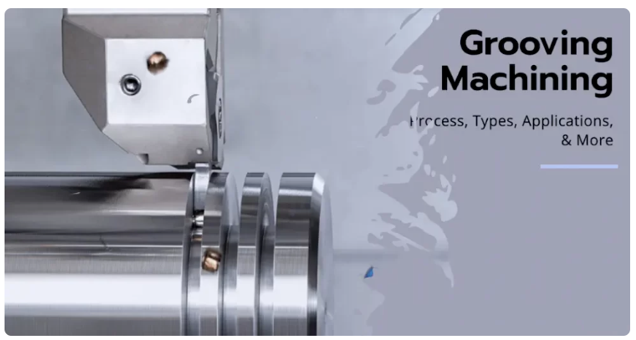
“Grooving operations can produce complex geometric features to ensure perfect part fit, combining precision with efficiency.”
First, what is a groove? It refers to a narrow, elongated cavity or recess on a workpiece. Grooves are critical geometric features in manufacturing, often used to accommodate secondary components such as seals, gaskets, or O-rings. Consequently, grooving creates slots and recesses for assembly clearances, joints, fittings, or specific functional purposes. CNC grooving technology employs lathes, turning centers, or other equipment to remove material along a defined path to form these grooves.
What is the grooving process?
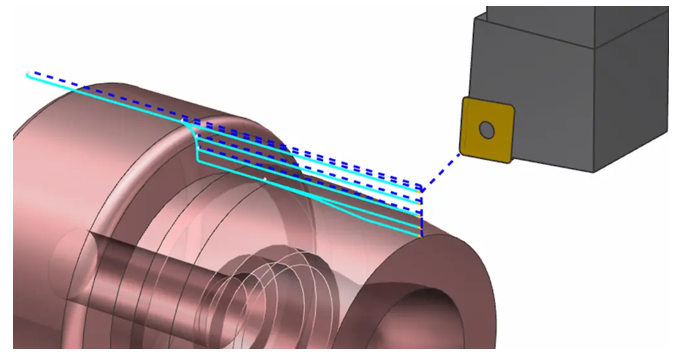
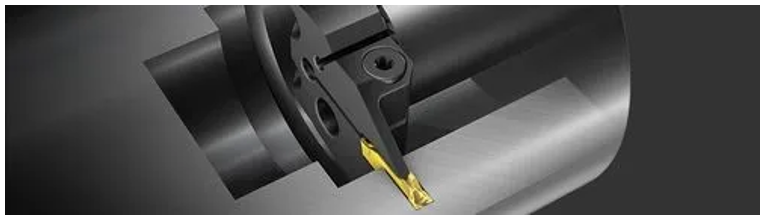
This subtractive manufacturing process involves feeding a suitable grooving tool into a rotating workpiece to form a cavity (either open or closed) that extends for a significant length relative to its small cross-sectional dimensions. The groove itself can take various shapes—cylindrical, angular, trapezoidal, or any irregular profile. The cutting tool is mounted on a tool holder capable of moving in multiple directions to shape the workpiece.
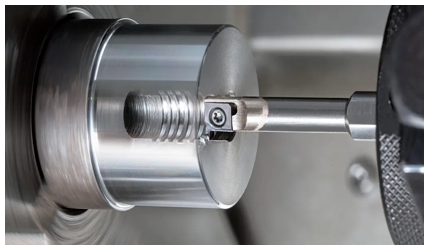
Grooving operations are categorized into external and internal grooving; a groove formed on the outer surface is known as external grooving, while internal grooving deals with the inner surfaces of hollow profiles.
Types of Grooving Operations
There are several types of grooving operations, with the appropriate method selected based on groove profile, dimensions, tooling, and application requirements. The correct type is chosen according to the specific groove specifications in the design. The following are some common CNC grooving operations:
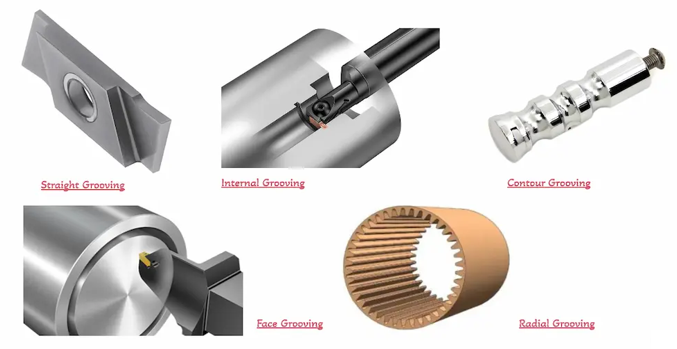
● Straight Grooving
This is the simplest form of grooving, involving the creation of a groove along the length of a cylindrical workpiece. Straight grooves can be used to create stepped diameters and custom slots for specific applications.
● Face Grooving
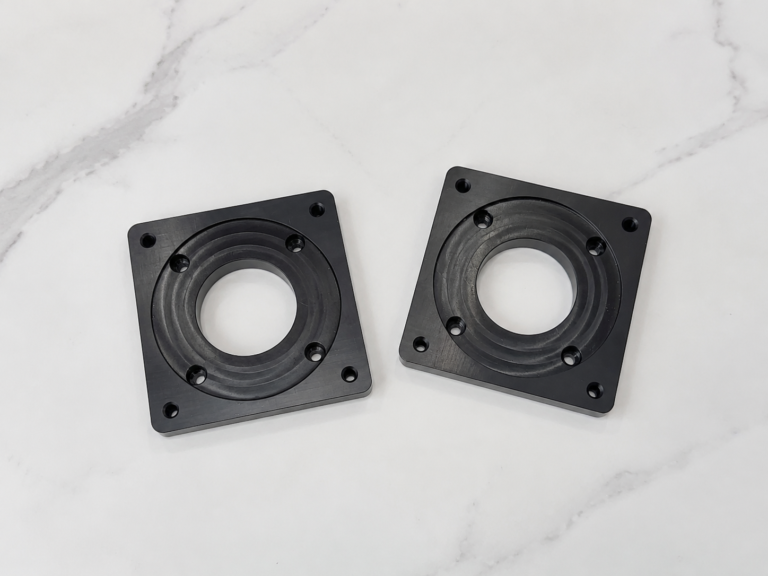
As the name implies, this process involves creating a groove on the front face of the workpiece by aligning the tool axially with the part. Face grooving inserts can access machining areas that are difficult to reach with other grooving processes.
● Internal and External Grooving
These grooving types are classified based on the surface being machined: the inner diameter (ID) surface or the outer diameter (OD) surface.
Internal grooving creates various channels and internal hollow features. The grooving tool tip is positioned slightly above the workpiece’s central axis—for example, when machining the interior of a steel pipe. On the other hand, external grooving is performed on the outer surface. It can also be accomplished using milling tools.
Whether internal or external, the groove profile can be linear, irregular, contoured, or any custom shape. These are commonly used for assembly and sealing purposes.
● Profile Grooving
This refers to custom grooves with specific shapes—as opposed to straight lines, circles, cylinders, or other standard geometric forms—essentially consisting of complex, irregular contours.
● Axial and Angular Grooving
Axial grooving refers to grooves running parallel to the workpiece axis; these are frequently used for features on cylindrical surfaces, such as keyways or shaft slots. Conversely, grooves cut at a specific angle relative to the workpiece axis are known as angular grooves.
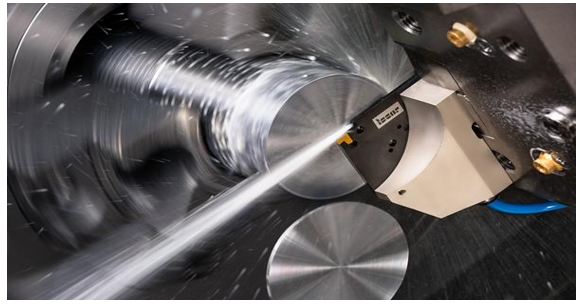
Materials Suitable for Grooving
CNC grooving can be used to machine metals, alloys, thermosets, composites, and thermoplastics.
Tool materials and machine parameters vary depending on the workpiece material, as different materials respond differently to tool movement based on their specific properties.
Metals and Alloys
Hard metals—such as tool steel, titanium, nickel, and various alloys—require grooving inserts with hard coatings (e.g., carbide, diamond, or tungsten carbide). Additionally, grooving speeds are high for soft metals but relatively slow for hard workpiece materials.
● Aluminum ● Brass ● Copper ● Steel and Stainless Steel Alloys ● Titanium ● Nickel Alloys
Plastics
Machining plastics requires careful attention, as even slight heat buildup can affect the workpiece, particularly during deep grooving operations. Optimizing cutting speeds, coolant flow, and tool selection is essential to prevent such issues.
● Acrylic ● Acrylonitrile Butadiene Styrene (ABS) ● Polycarbonate ● Teflon (PTFE) ● Polyoxymethylene (POM/Acetal)
Other Materials
In addition to plastics and metals, grooving features can also be created on ceramics and composite materials. ● Alumina and Zirconia ● Carbon Fiber Reinforced Polymer (CFRP) ● Glass Fiber Reinforced Polymer (GFRP) ● Kevlar-reinforced composites, etc.
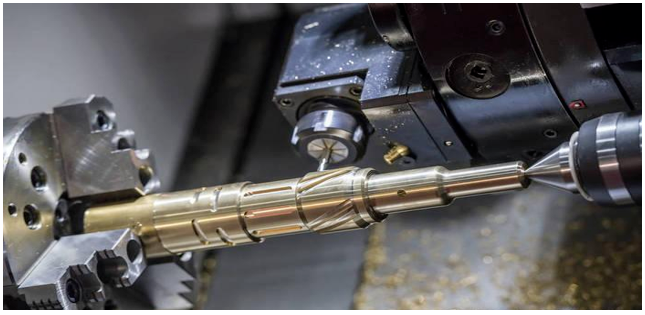
Grooving Tips
Ensuring Machine Stability
Machine stability encompasses not only a solid base or floor support but also the precise fit and setup of every component to minimize vibration during operation.
Workpiece Clamping Force
Insufficient clamping force can cause the workpiece to come loose, while excessive force can lead to material deformation. Therefore, applying the correct clamping force is crucial. Typically, the clamping force should exceed the cutting force.
Clamping Force = 1.5 to 2 × Cutting Force (Fc), or Fc ≤ Clamping Force ≤ 2Fc
Aligning the Grooving Tool with the Workpiece
Any misalignment between the grooving tool and the workpiece can result in inaccuracies, tool defects, wear, and breakage. Consequently, proper calibration and alignment procedures should be followed prior to machining.
Selecting the Right Grooving Tool
Choose tools and inserts based on the shape, dimensions, and profile of the groove. Compatibility between the tool material and the workpiece material is essential.
● Parting-off tools
● ID and OD grooving tools
● Full-radius grooving tools, etc.
Radial Feed Roughing
This process involves removing a large amount of material to create a near-net-shape groove before performing a finishing pass to achieve the final depth. It is accomplished by feeding the tool radially into the workpiece. This technique is suitable when speed is prioritized over high precision.
Efficient Chip Evacuation
CNC grooving typically employs two chip evacuation methods: chip curling (width-wise) or chip rolling. Ensure the groove width accommodates the chip length to prevent heat buildup. Using the appropriate coolant can also effectively mitigate heat-related issues.
Even slight deviations or misalignments in grooving parameters can significantly impact precision and overall production quality. Paying attention to these details helps ensure smooth operation and the desired results.
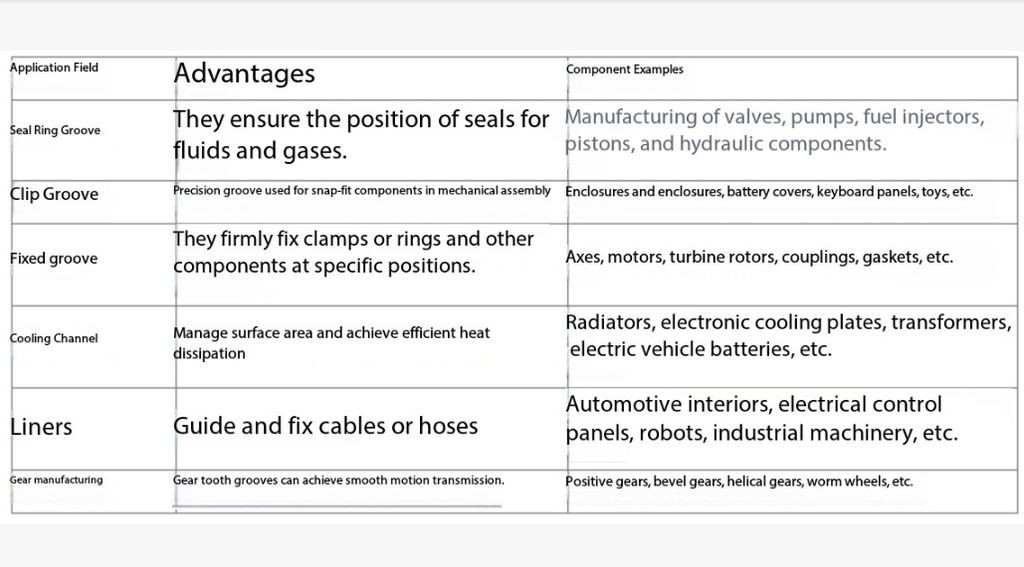
What are the applications of grooving?
What is CNC V-grooving?
CNC V-grooving involves creating a V-shaped groove at the location where a metal sheet is to be bent. It facilitates bending without deformation and allows for the adjustment of the bend radius. CNC V-bits with various angles (e.g., 60°, 90°, 120°) are used during this process.
V-grooving thick sheets reduces bending force and facilitates the positioning or alignment of bend lines. These grooves are utilized for decorative components, electronic panels, enclosure bending, HVAC ductwork, and other similar applications.
What is a deep groove?
While there is no strict definition or specific value for “deep groove” depth, it is generally considered to be half the thickness of the workpiece. For thin workpieces (less than 1.5 mm), deep grooving is performed using Swiss-type lathes or standard lathes, with depths typically limited to a maximum of 0.5 mm.
Ensuring proper tool paths, correct feed rates and speeds, and the right choice of tooling is crucial for precision deep grooving. Failure to do so can result in poor groove-bottom flatness, inferior surface finish, material deformation, cracking, or even component failure.
Summary
Grooves are essential for sealing, snap-fit assemblies, cooling channels and cavities, gear manufacturing, and many other applications. Using the right grooving tools and machining parameters, while accounting for the workpiece material, ensures seamless grooving operations and optimal results.
Furthermore, the expertise of engineers and operators, the capabilities of the grooving equipment, and quality control protocols all play a significant role in determining the quality of the machined grooves.