thread milling CNC service supplier
Overview of Thread Milling
With the widespread adoption of CNC machine tools, thread milling technology is increasingly utilized in the machinery manufacturing industry. Thread milling creates threads through the simultaneous three-axis motion of a CNC machine tool, using a thread milling cutter to perform helical interpolation; for every full circular rotation the cutter makes in the horizontal plane, it advances linearly by one thread pitch in the vertical plane. Thread milling offers numerous advantages, including high machining efficiency, superior thread quality, excellent tool versatility, and enhanced machining safety.
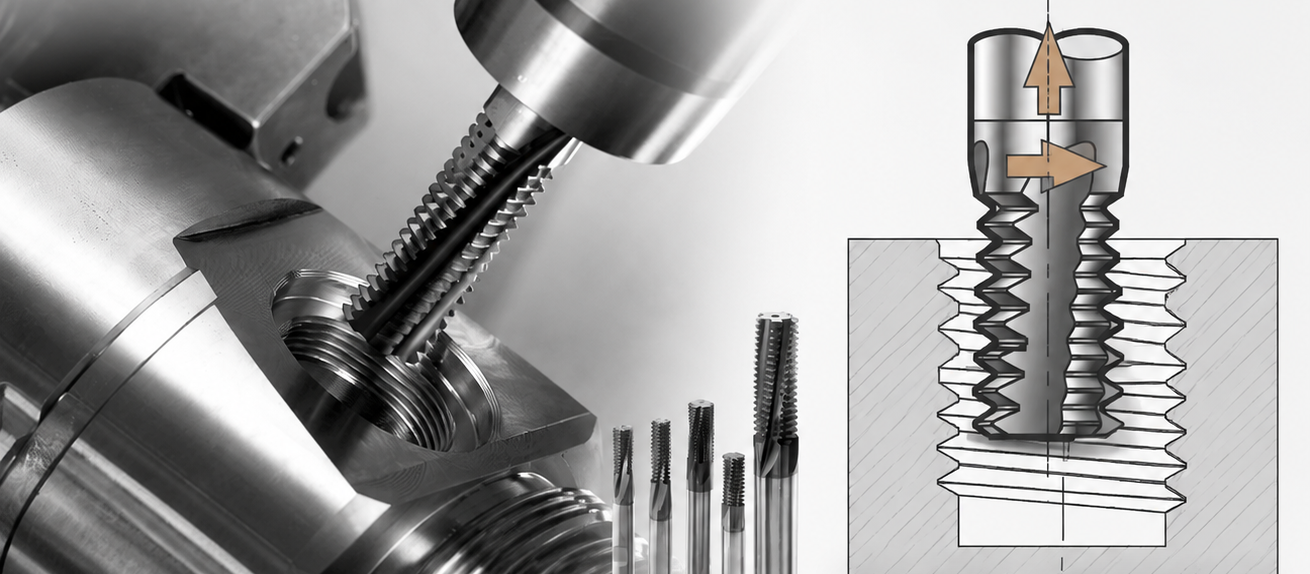
Cooling is also critical during thread milling; the use of machine tools and cutters equipped with internal cooling capabilities is recommended. When the cutter rotates at high speeds, centrifugal force makes it difficult for externally applied coolant to reach the cutting zone. Internal cooling not only effectively cools the tool but—more importantly—facilitates chip evacuation when machining blind-hole threads. High internal cooling pressure is particularly essential when machining small-diameter internal threads to ensure smooth chip removal. Furthermore, selecting a thread milling cutter requires a comprehensive assessment of specific machining requirements, such as production batch size, the number of threaded holes, workpiece material, thread precision, and dimensional specifications.
Practical Application of Thread Milling:
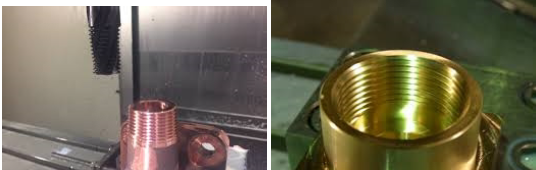
Due to its many advantages, CNC thread milling has been widely adopted by manufacturing enterprises. Experimental research led to the use of thread milling for the connector threads on a complex engine component, yielding excellent results; the process and methodology are briefly described below.
- Part Characteristics and Machining Challenges
The component in question is a critical engine part. If turning were used to machine the connector threads, the fact that the main body and the connector do not share the same axis of rotation would complicate workholding and positioning; however, thread milling allows for convenient clamping and machining.
- Tool Selection
A three-axis CNC machine tool and a thread milling cutter are the two essential elements for thread milling. Several common types of thread milling cutters are described below.
Cylindrical Thread Milling Cutter
For cylindrical thread milling cutters, the helical pitch during machining is achieved through the movement of the machine tool. Due to this specific design, the cutter can produce both right-hand and left-hand threads; however, it is not suitable for threads with large pitches. It is best suited for milling small-to-medium diameter threads, offering stable cutting performance and high durability. Its main drawback is the high cost of manufacturing and purchasing the tool.
Indexable Thread Milling Cutters and Inserts
Indexable thread milling cutters are suitable for machining larger diameter threads (e.g., 25mm). They feature inserts that are easy to manufacture and cost-effective. A key advantage is the ease of insert replacement, which helps reduce overall machining costs.
Modular Multi-Station Thread Boring and Milling Cutter
The modular multi-station thread boring and milling cutter features a multi-edge design that allows for the completion of multiple machining operations in a single pass. This saves time on auxiliary tasks like tool changes and significantly boosts productivity. This type of modular tool can simultaneously machine internal threads, chamfers, and flat surfaces on the workpiece.