Why Wafer Locating Ring Roundness Changed After Thermal Cycling

Wafer locating ring roundness met the drawing requirement during final room-temperature inspection. The locating diameter, flatness, and mounting features were all within tolerance.
After repeated heating and cooling cycles, however, the ring developed a small oval condition. The change was enough to affect wafer clearance and repeatable positioning.
Because the dimensions returned only partially after cooling, the issue was not simple thermal expansion.
Measuring the Change by Temperature Stage
The ring was measured before cycling, at the operating temperature, and again after returning to the controlled inspection room.
Diameter readings were taken in several directions rather than at only two points. This showed that one axis expanded and recovered differently from the perpendicular axis.
The maximum roundness error appeared near mounting features where the cross-section was less uniform.
Recording the complete thermal history helped separate temporary expansion from permanent shape change.
Residual Stress in the Material
A thin ring can contain residual stress from raw-material production, heat treatment, straightening, or previous machining.
During CNC machining, material was removed from the inside and outside surfaces. This changed the balance of the internal stress while the fixture continued to hold the ring in a circular condition.
Heating during service allowed part of the stress to relax. After cooling, the ring settled into a slightly different shape.
Material condition and certification were therefore reviewed before changing tool compensation.
Balancing the Machining Sequence
The original process removed most material from one side before completing the opposite surface.
The revised sequence alternated material removal between the inner diameter, outer diameter, and two faces. Uniform finishing stock was left around the circumference.
Rough machining was separated from final finishing by a stabilization period. Where the tolerance required it, an intermediate thermal-stabilization cycle was completed before the final locating diameter was machined.
Light finishing cuts reduced cutting force and local heat on the flexible ring.
Controlling Clamping Distortion
The original fixture used several clamps around the circumference. Minor variation in tightening force could force the ring into a circular shape during machining.
After release, the component recovered toward its unstressed form. Thermal cycling made this movement more visible.
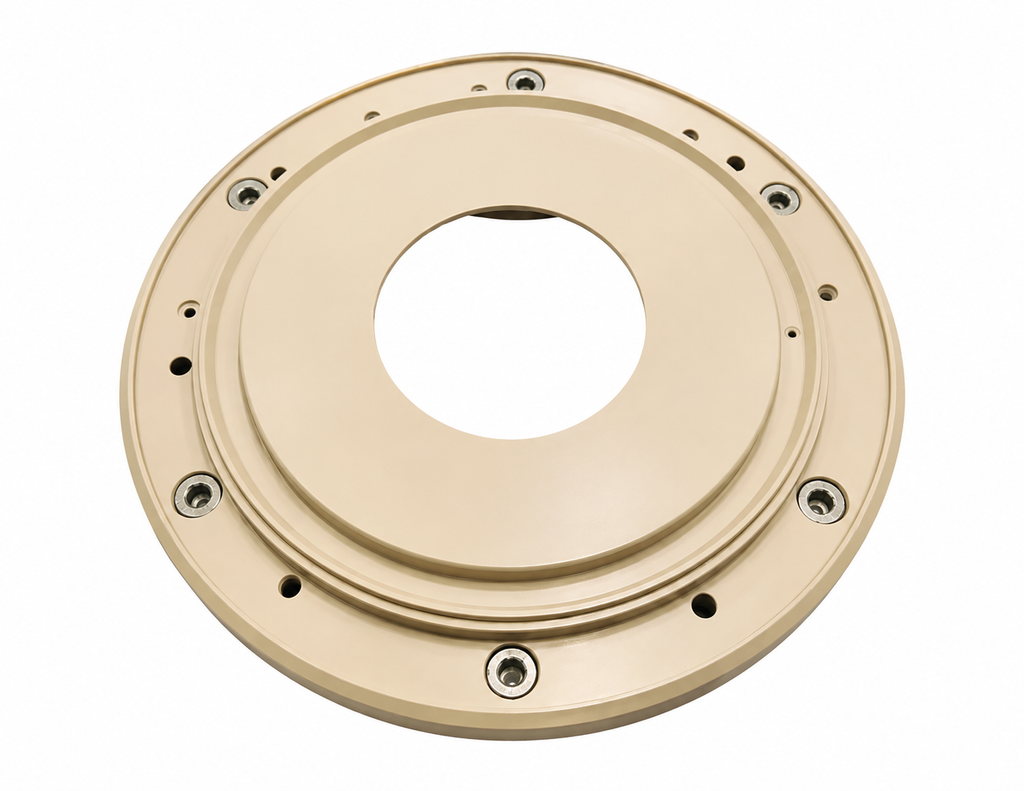
A full-contact or segmented support fixture was introduced to distribute force more evenly. Clamping pressure and tightening sequence were standardized.
Final roundness was always measured after the ring had been removed from the fixture.
Reviewing Mounting Features
Mounting holes, slots, reliefs, and local cutouts reduced stiffness at specific positions around the ring.
The relationship between these features and the measured oval direction was reviewed. Where design changes were permitted, transitions were made smoother and local sections were balanced.

Fastener clearance and assembly torque were also checked because the ring could distort again when installed, even if the free-state inspection result was acceptable.
Verifying Thermal Stability
The corrected rings were inspected before and after the specified number of thermal cycles.
Roundness, locating diameter, flatness, and hole position were measured at a controlled temperature after sufficient stabilization time. Functional clearance with the wafer or a representative gauge was also verified.
The revised material preparation, balanced machining, and clamping method kept roundness within tolerance after cycling.
This wafer locating ring roundness case shows that room-temperature inspection alone may not confirm functional stability. Material stress, section symmetry, workholding, thermal history, and assembly conditions must be evaluated together.
We manufacture precision rings, wafer-handling components, vacuum-system parts, and semiconductor fixtures. Send us your drawing, material, operating-temperature range, roundness tolerance, and thermal-cycle requirement for a manufacturability review.