Controlling Frequency Through RF Filter Cavity Machining
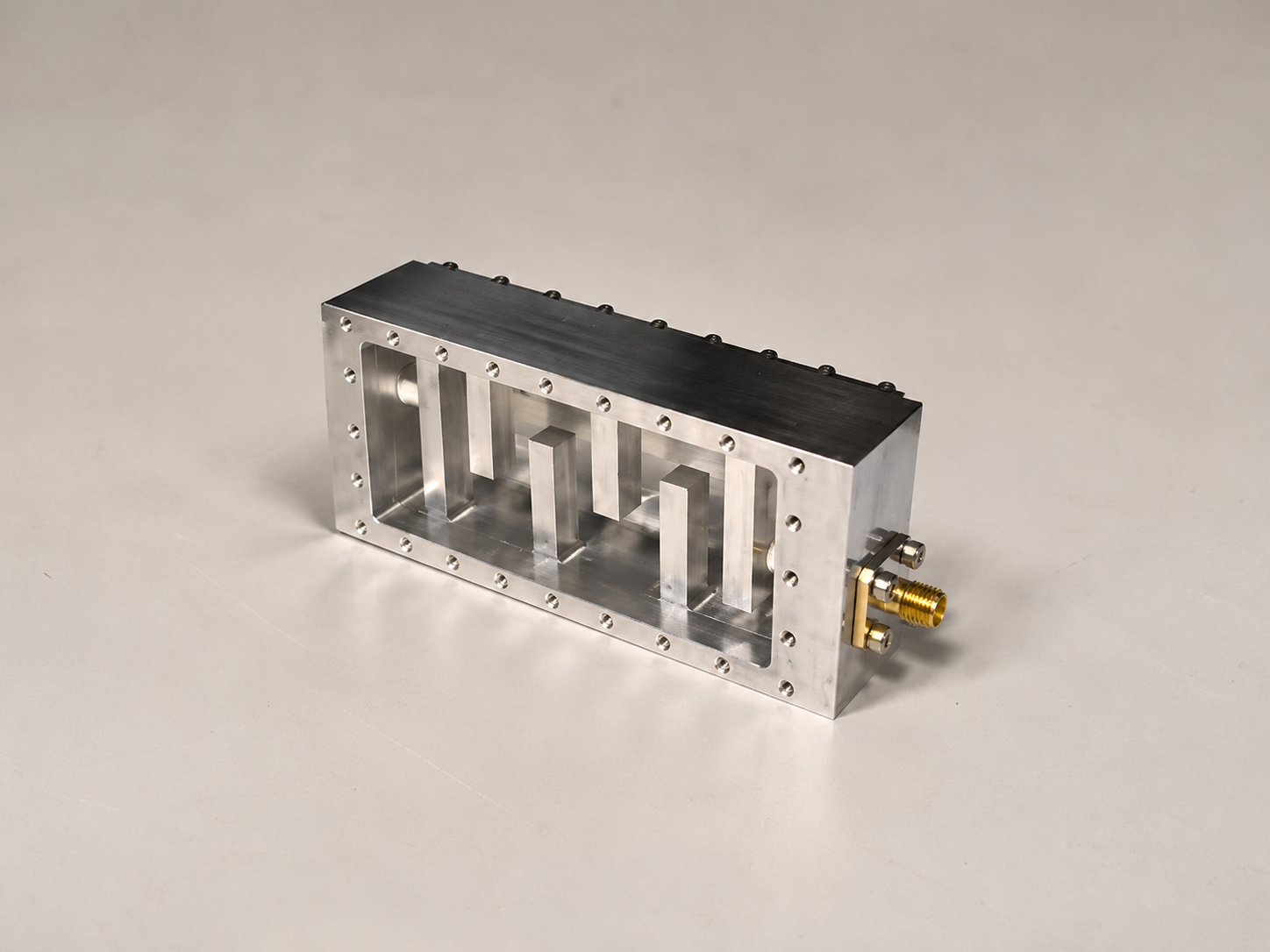
RF filter cavity machining became the focus when a completed aluminum cavity passed dimensional inspection but showed a frequency shift during RF testing.
The main dimensions appeared acceptable, and the component assembled correctly with its cover. However, the tuning range was close to its limit, leaving insufficient adjustment margin.
The investigation showed that several small manufacturing variations were acting together rather than one dimension being clearly out of tolerance.
Identifying the Functional Geometry
A filter cavity contains features that directly influence electromagnetic performance.
Cavity depth and width affect the resonant volume. Resonator position, post diameter, coupling openings, and the distance to the cover influence frequency and bandwidth.
Internal corner radii also change the effective geometry. A cavity machined with a larger-than-expected tool radius may pass a simplified linear inspection while still producing a different electrical result.
The critical dimensions were therefore identified with the RF design team before the machining process was revised.
Controlling Cavity Depth
The cavity floor was used as a functional surface rather than treated as a general pocket bottom.
Rough machining left uniform material for finishing. A dedicated final pass controlled depth relative to the cover-sealing face.
Tool deflection, spindle growth, and material temperature were considered because the depth tolerance was distributed across a relatively large machined area.
Depth measurements were taken at several positions to identify tilt or local variation instead of checking only one point.
Maintaining Resonator Position
The resonator post and coupling features were machined from the same datum system as the cavity.
Where possible, these features were completed in one setup to reduce positional error from reclamping. A probe confirmed the work offset before finishing the critical geometry.
Small posts were machined using light cuts to limit deflection. Their diameters and positions were inspected together because a correct post size could not compensate for an incorrect location.
Managing Tool Radii and Surface Finish
The cutting tool was selected according to the permitted internal corner radius, not only the pocket size.
Rest machining removed material left by larger roughing tools without repeatedly cutting the complete cavity. This reduced unnecessary cycle time and prevented local overcutting.
The cavity surfaces received a controlled finish. Heavy polishing was avoided because it could round critical edges, change coupling slots, or reduce post dimensions.
Burrs were removed carefully from openings and threaded features because loose particles could affect assembly and electrical performance.
Allowing for Surface Plating
The cavity required a conductive surface treatment. Plating thickness was considered on resonator posts, coupling features, threaded holes, and internal cavity walls.
Critical dimensions were defined according to whether they applied before or after plating. Masking was specified where coating buildup could interfere with grounding or mechanical fits.
The plated component was cleaned and inspected before RF testing to prevent residue from affecting contact between the cavity and cover.
Linking Inspection to RF Results
Dimensional results were compared with frequency-test data rather than reviewed separately.

The corrected process improved cavity-depth consistency, resonator position, and available tuning range. The assembled filter reached the target response without excessive adjustment.
This RF filter cavity machining case shows that mechanical inspection alone may not predict electrical performance. Functional geometry, tool radii, datum control, surface condition, plating thickness, and RF testing must be planned together.
We manufacture individual RF filter cavities, waveguide components, resonator housings, and precision aluminum microwave parts. Send us your 3D model, critical dimensions, plating requirement, frequency range, and inspection standard for a manufacturability review.